Hey there, have you ever sat glued to your screen during the Olympics, heart pounding as an athlete crosses the finish line or sticks that impossible landing? That moment when the national anthem plays and the gold medal drapes around their neck—it’s electric, right? I know I get chills every time. But then, in the quiet aftermath, a question sneaks in: how much is a gold medal worth? Not just the shiny disc itself, but the sweat, the sacrifices, the sheer human spirit poured into it.
Today, let’s chat about that. We’ll peel back the layers, from the cold hard cash to the stories that make it priceless. Stick with me; this isn’t just about numbers—it’s about what drives us all to push a little harder.
As someone who’s chased my own modest goals—training for that half-marathon that left me hobbling for days, or nailing a work presentation after sleepless nights—I see echoes of those athletes in everyday life. So, if you’re wondering how much is a gold medal worth beyond the podium, you’re in good company. Let’s dive into the real story.
The Tangible Side: What Goes Into Crafting a Gold Medal
Picture this: a quiet workshop, artisans hunched over workbenches, turning raw ambition into something you can hold. Okay, maybe not your ambition, but close enough. The physical creation of a gold medal starts with decisions that blend tradition and tech. At its core, these aren’t solid gold bars like in the movies. Most are a mix—often silver plated with a thin layer of gold to keep costs in check while preserving that gleam.
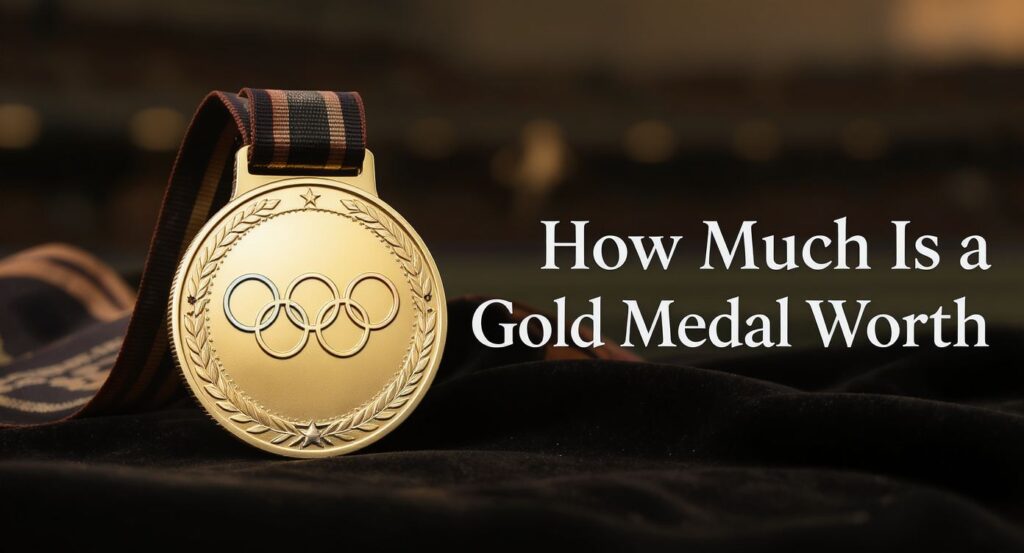
Take the Olympics, for instance. The International Olympic Committee sets guidelines, but each host city adds its flair. For Tokyo 2020 (which we all remember as 2021), they recycled old electronics for sustainable bling. Cool, huh? But let’s get to the brass tacks: how much is a gold medal worth in raw materials? A typical Olympic gold weighs about 500-600 grams, with around 6 grams of actual gold plating. At current gold prices—hovering near $2,500 per ounce—that plating alone might fetch $300 to $400 if melted down. The silver base? Another $200 or so. Total melt value: under $600. Not exactly pirate treasure.
But manufacturing bumps it up. Engraving, ribbon crafting, quality checks—think $1,000 to $2,000 per medal for production. And that’s before shipping and ceremonies. I once visited a local award ceremony where they handed out custom medals for a charity run. The organizer confessed they spent $15 a pop, but the joy on runners’ faces? Worth every penny. Scale that to Olympic levels, and you’re looking at a production cost of $5,000 or more per piece, depending on the year and design.
Breaking Down the Costs: Materials, Labor, and Legacy
Ever wondered why they don’t just hand out gold bars? Practicality, my friend. Pure gold is soft; it’d dent in a victory hug. So, the alloy mix ensures durability. Labor-wise, skilled jewelers and designers pour hours in. For Paris 2024, they drew inspiration from Greek antiquity, with intricate engravings of ancient athletes. That artistry? It adds hundreds to the bill.
If you’re crunching numbers like I do after a big purchase, factor in rarity. Only a handful go to winners each event—about 300 golds per Summer Games. Supply and demand nudge the value higher on the resale market, but we’ll circle back to that. For now, know this: the tangible how much is a gold medal worth hovers between $500 and $2,000 in direct costs. It’s a steal compared to what it represents.
Olympic Gold: A Closer Look at the Pinnacle Prize
When people ask how much is an Olympic gold medal worth, eyes light up. It’s the holy grail of sports, right? That five interlocking rings symbolize global unity, personal grit, and moments that redefine lives. But let’s zero in: how much is a gold Olympic medal worth today? Beyond the IOC’s no-sell policy for active athletes (they’re meant to stay with the winner or be donated), the street value starts at that melt-down figure we discussed—say, $550 for Paris 2024’s version.
Yet, auctions tell a different tale. A 1904 St. Louis gold fetched $50,000 in 2019, not for the metal, but the history. Why? Because it’s tied to legends like Archie Hahn, who sprinted to glory when the Games were more circus than spectacle. Fast-forward to modern eras: Jesse Owens’ 1936 Berlin medals have commanded six figures, a nod to his defiance against tyranny.
I remember my grandfather recounting Owens’ story over family dinners. He’d mimic the crowd’s roar, eyes misty, explaining how one man’s speed shattered barriers. That’s the hook—medals aren’t just awards; they’re time capsules. So, if you’re pondering how much is a gold Olympic medal worth, it’s $500 in scrap, but potentially millions in meaning.
The Rarity Factor: Why Some Golds Shine Brighter
Not all golds are created equal. Early 20th-century ones, like those from Stockholm 1912, were solid gold—92.5% pure, weighing over 300 grams. How much is a 1912 Olympic gold medal worth today? Melt it down, and you’d pocket about $25,000 at today’s prices. But collectors? They pay 10 times that. A 1912 wrestling gold sold for $137,000 in 2012, bought by a Swedish museum to honor Hjalmar Johansson, the multi-sport champ who lived to 98.
What makes it special? The era’s innocence—fewer nations, raw competition. Athletes like Jim Thorpe, stripped of his medals for “amateur” violations, add drama. Thorpe’s story hits hard; he was Native American, overcoming poverty to win pentathlon and decathlon golds, only to have them yanked. They were returned posthumously in 1983. If you could snag one, it’d be a conversation starter forever. Personally, I’d frame it with Thorpe’s photo, a reminder that value isn’t always immediate.
Historical Gems: Tracing the Evolution of Medal Value
Medals have morphed since Baron de Coubertin’s revival in 1896. Back then, golds were fully gilded silver, costing a few dollars in today’s money. Fast-forward, and we’ve seen shifts: Beijing 2008 used jade accents; Rio 2016 went eco with recycled materials. Each tweak reflects the times, influencing how much is a gold medal worth.
Take the 1912 Games again. Stockholm’s edition was a turning point—women debuted in swimming, and the pentathlon tested all-around prowess. A how much is a 1912 Olympic gold medal worth today query often lands on auction sites like Sotheby’s. One from the shooting event went for $62,000 last year, its patina whispering of pre-WWI optimism.
I’ve pored over old footage, imagining the athletes’ nerves. One diver from those Games, Erik Adlerz, won gold despite a family tragedy. His medal? Now valued at over $100,000, but to him, it was redemption. History like that elevates the price tag, turning metal into memoir.
From Ancient Laurels to Modern Medallions
Roots go deeper—to ancient Greece, where olive wreaths crowned victors, worth more in prestige than produce. Coubertin modernized it, but the spirit endures. By the 1920s, golds were standardized, yet costs rose with inflation. A 1924 Chamonix winter gold? Melt value $1,200; auction $40,000.
Stories abound: Sonja Henie’s figure skating golds from the ’20s and ’30s now fetch $200,000+, blending sport with Hollywood glamour. She skated into movies post-Olympics, her medals props in a life of reinvention. If you’re a history buff like me, these tales make how much is a gold medal worth a journey through eras, not just eBay listings.
The Emotional Core: Stories That Make Medals Matter
Alright, let’s get real—numbers are fun, but they don’t capture the goosebumps. How much is a gold medal worth when it’s the culmination of a kid’s dream? I think of my cousin, a swimmer who missed nationals by a touch but swam through a torn rotator cuff. No gold, but her grit? Pure gold.
Athletes echo that. Michael Phelps, with 23 golds, once said each felt heavier than the last—not from weight, but emotion. His 2008 Beijing haul, including that epic 100m butterfly photo finish, nets millions if auctioned piecemeal. But Phelps donates proceeds to causes, proving value loops back to impact.
Then there’s Kerri Strug’s 1996 vault—vaulting on a busted ankle for team gold. Her medal? Worth $50,000 today, but the clip replays in my mind as a masterclass in courage. These narratives connect us; they remind you that your daily grind has podium potential.
Athlete Voices: Triumphs, Tears, and Takeaways
Chat with Olympians, and how much is a gold Olympic medal worth shifts. Simone Biles values hers at “everything,” pausing her career for mental health in 2021. Her return in 2024, grabbing three golds? Each one’s auction estimate: $100,000+, but she’d never sell. Why? They symbolize resilience.
Or Usain Bolt’s 2008 sprints—medals worth $150,000 apiece now, yet he jokes they’d buy a fast car. Bolt’s laugh, that lightning bolt pose—it’s infectious. I tried mimicking it at a track meet once; tripped, laughed harder. His story teaches joy in pursuit, making any “worth” feel secondary.
Pain points hit home too. Many athletes fundraise for gear, balancing jobs with training. A gold validates it all, but the journey forges character. If you’re sidelined by doubt, like I was post-injury, remember: the medal’s shine starts in struggle.
2024 Spotlight: Fresh Golds and Fresh Perspectives
Now, how much is a gold medal worth 2024? Paris delivered spectacle—Seine-side ceremonies, Lady Gaga opening vibes. Medals featured hexagon designs, echoing Eiffel Tower rivets, weighing 529 grams with 18 grams of gold plating. Melt value? About $600, per the French Mint.
But buzz around sales is early. Noah Lyles’ 100m gold might hit $200,000 in a decade, given his charisma. Suni Lee’s all-around? Already a symbol for Hmong Americans, priceless in cultural weight.
I tuned in from my couch, yelling at the TV like a coach. That shared thrill? It’s why we watch. For 2024 winners, the medal’s immediate worth is opportunity—sponsorships, books, speaking gigs adding millions. Yet, many stash them away, heirlooms for kids chasing dreams.
Auction Trends and Future Forecasts
Post-Games, eyes turn to heritage auctions. A 2024 bronze (ironic, since bronzes are cheapest at $300 melt) could rise with story. Golds? Expect $10,000 starters, climbing with fame. Experts predict inflation and collector demand pushing averages up 15% yearly.
My bet: sustainability angles boost value. Paris’ recycled medals appeal to eco-conscious buyers. If you’re investing—hey, who isn’t daydreaming?—focus on narratives. A medal from an underdog? That’s where the real return lies.
The Market for Medals: Buying, Selling, and Stories Sold
Ever browsed auction catalogs, heart racing at a “lot” description? How much is a gold medal worth skyrockets here. Platforms like Heritage Auctions host sales, where provenance rules. Jesse Owens’ again: $1.4 million for his full set in 2013.
Sellers often heirs or estates. Johnny Weissmuller’s 1924 swimming golds—Tarzn himself—sold for $114,000. Imagine the tales: from pool to jungle sets. I once bid on a vintage track ribbon (lost, naturally); the thrill mimicked owning history.
Regulations apply—IOC frowns on sales, but can’t stop them. Proceeds fund scholarships, softening the sting. For buyers, it’s legacy-building. A collector I met displayed his 1932 medal like family photos, sharing the athlete’s letters. That intimacy? Beats any bid.
Iconic Sales That Captured Headlines
Recall Michael Johnson’s 200m gold from 1996? Auctioned for $120,000 in 2019, bought by a foundation. Or the 1900 Paris tug-of-war gold—yes, that was Olympic—fetching $57,000 for its whimsy.
These sales spotlight how much is a gold Olympic medal worth: $50,000 to $2 million, median $250,000. Factors? Condition, event prestige, athlete fame. A 1912 pentathlon piece? $250,000 easy, evoking Thorpe’s ghost.
One caveat: fakes lurk. Verify with experts; I’ve dodged sketchy eBay “golds” that screamed souvenir. Authenticity amps value, like trust in friendships—once broken, hard to mend.
Beyond the Podium: Lessons for Everyday Victories
So, circling back, how much is a gold medal worth? Financially, it’s variable—$600 melt for 2024, $25,000+ for 1912 relics, auction highs in the millions. But strip the dollars, and it’s the fire it ignites.
Think of your wins: that promotion after grinding spreadsheets, the family vacation earned through side hustles. No medal, but same glow. I chased a writing goal last year—daily pages, rejections piling up. “Gold” was the finished manuscript, worth every skipped Netflix night.
Athletes teach us that. Katie Ledecky’s 800m freestyle golds? Each a lap in persistence. Her advice: celebrate small strokes. Apply that, and your “medals” multiply.
If life’s hurdles feel Olympic-scale, pause. Recall a Strug vault or Bolt dash. You’re built for it. And hey, if you snag a real one someday—through coaching a champ or sheer luck—treasure the tale over the tag.
What about you? Ever had a “gold” moment that redefined worth? Drop it in the comments; let’s swap stories. Until next time, keep chasing that shine—it’s closer than you think.