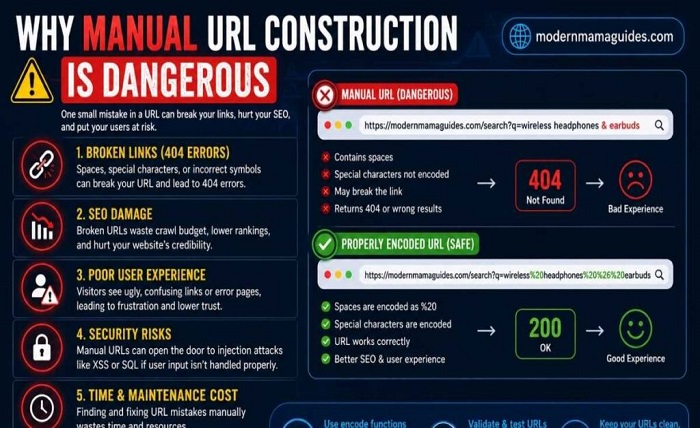
The term url encoder and decoder spellmistake usually pops up when someone types “url encoder and decoder” but adds an extra word or typo like “spellmistake” while searching. Despite the typo, the intent is clear: you want to understand how to convert special characters in URLs into a safe format and reverse the process. URL encoding replaces unsafe ASCII characters with a % followed by two hexadecimal digits. Decoding does the opposite. When you see “url encoder and decoder spellmistake” in search logs, it’s often developers, marketers, or SEO folks troubleshooting broken links caused by spaces, &, #, or non-Latin characters. Knowing the mechanics behind url encoder and decoder spellmistake saves you from 404 errors, broken API calls, and malformed query strings that kill user experience and tracking.
Why URL Encoder and Decoder Spellmistake Matters for SEO and Web Dev
Every time you deal with url encoder and decoder spellmistake issues, you’re actually dealing with how browsers interpret your links. Unencoded spaces become %20, + signs in query strings can mean space, and emojis or UTF-8 characters turn into longer percent-encoded sequences. If you ignore url encoder and decoder spellmistake rules, your canonical tags, hreflang URLs, and social share links can break. Search engines might index two versions of the same page — one encoded, one not — causing duplicate content issues. APIs will reject requests if parameters aren’t properly encoded. So mastering url encoder and decoder spellmistake isn’t pedantic; it’s core to keeping your site crawlable, shareable, and functional across platforms.
How URL Encoder and Decoder Spellmistake Works Under the Hood
To really get url encoder and decoder spellmistake, look at RFC 3986. It defines which characters are “reserved” and “unreserved” in a URI. Unreserved = A-Z a-z 0-9 - _ . ~. Everything else should be percent-encoded. An encoder scans your string, leaves unreserved chars alone, and converts others. Example: hello world? becomes hello%20world%3F. A decoder reverses it. The confusion around url encoder and decoder spellmistake often comes from application/x-www-form-urlencoded, used in POST data and query strings, where space = + and ~ might be encoded even though it’s unreserved. JavaScript’s encodeURI vs encodeURIComponent vs escape also trips people up. If you search url encoder and decoder spellmistake, you probably hit one of those edge cases where the wrong function mangled your URL.
|
Function |
Encodes |
Use Case for URL Encoder and Decoder Spellmistake |
|---|---|---|
|
|
Does not encode |
Encoding a full URL |
|
|
Encodes |
Encoding a query param value |
|
|
Decodes all percent codes |
Reversing param values |
Understanding this table prevents most url encoder and decoder spellmistake headaches.
Common URL Encoder and Decoder Spellmistake Errors and Fixes
The phrase url encoder and decoder spellmistake shows up a lot because the errors are so common. Here are the big ones:
- Double encoding: You encode
name=John Smithtoname=John%20Smith, then encode again toname=John%2520Smith. The fix for this url encoder and decoder spellmistake is to decode once before re-encoding. - Using
encodeURIon parameters: It leaves&and=untouched, breaking your query string. The url encoder and decoder spellmistake solution isencodeURIComponentfor individual values. - Unicode issues:
caféshould becaf%C3%A9, notcaf%E9. Modern UTF-8 encoding solves this url encoder and decoder spellmistake. - Plus vs %20: In URLs,
%20is safest. Inx-www-form-urlencodedbodies,+is expected. Mixing them is a classic url encoder and decoder spellmistake. - Copy-paste from browsers: Chrome’s address bar shows decoded URLs, but copying sometimes gives you encoded or decoded versions unexpectedly. Verify before you paste to avoid url encoder and decoder spellmistake bugs.
Run any suspicious URL through a decoder, inspect it, then re-encode with the right function. That workflow clears 90% of url encoder and decoder spellmistake issues.
Top Tools to Handle URL Encoder and Decoder Spellmistake Online
When you Google url encoder and decoder spellmistake, you want a quick tool, not a spec. Here are reliable options:
- Browser DevTools: Open Console, run
encodeURIComponent('your string')ordecodeURIComponent('%20'). Fastest way to test url encoder and decoder spellmistake cases. - Online encoders: Sites like urlencoder.org, Meyerweb’s tool, or LambdaTest give instant results. Paste, click, done. They help visualize url encoder and decoder spellmistake problems.
- VS Code extensions: “Encode Decode” or “URL Encode” let you transform selected text without leaving your editor, preventing url encoder and decoder spellmistake during coding.
- Python/Node one-liners:
python -c "import urllib.parse; print(urllib.parse.quote('input'))"ornode -e "console.log(encodeURIComponent(process.argv[1]))" -- "input". Scripting avoids manual url encoder and decoder spellmistake repetition. - Postman: It auto-encodes params, but has a toggle. If your API fails, check if Postman’s encoding matches your server expectation to debug url encoder and decoder spellmistake.
Pick one and keep it in your bookmarks. You’ll use it weekly once you start noticing url encoder and decoder spellmistake in the wild.
Developer Code Examples for URL Encoder and Decoder Spellmistake
Code makes url encoder and decoder spellmistake concrete. Here’s how major languages handle it:
JavaScript
URL Encoding & Decoding BasicsPython
from urllib.parse import quote, unquote# URL Encoder and Decoder Spellmistake exampleencoded = quote('url encoder and decoder spellmistake') decoded = unquote(encoded)PHP
// URL Encoder and Decoder Spellmistake in PHP$encoded = rawurlencode('url encoder and decoder spellmistake');$decoded = rawurldecode($encoded);Notice rawurlencode vs urlencode in PHP. The former follows RFC 3986 and uses %20, while urlencode uses +. Choosing wrong is a classic url encoder and decoder spellmistake. Always match your backend’s expectation.
Best Practices to Avoid URL Encoder and Decoder Spellmistake Problems
To stop typing url encoder and decoder spellmistake into Google at 2am, build these habits:
- Encode at the last moment: Build your URL with raw values, then encode right before the request. This prevents double-encoding, a major url encoder and decoder spellmistake.
- Validate inputs: Strip or reject newlines and control characters before encoding. They create weird
%0Aartifacts that look like url encoder and decoder spellmistake. - Log both forms: When debugging, log the raw and encoded URL. If you see
%25, you’ve found a url encoder and decoder spellmistake. - Standardize on UTF-8: Make sure your app, database, and server all use UTF-8 so
üis always%C3%BC, not?, avoiding url encoder and decoder spellmistake mojibake. - Write tests: Unit test your URL builder with spaces,
&,#,=,+, and emoji. Automated tests catch url encoder and decoder spellmistake before prod does.
Treat URLs like user input: never trust, always encode. That mindset eliminates most url encoder and decoder spellmistake incidents.
Conclusion
The weird keyword url encoder and decoder spellmistake is really just a symptom of how often developers and marketers run into encoding bugs. URLs look simple, but reserved characters, UTF-8, and different encoding standards turn them into minefields. By understanding RFC 3986, using the right function for the right context, and keeping a decoder tool handy, you turn url encoder and decoder spellmistake from a frustrating search query into a non-issue. Encode late, decode when debugging, and test with ugly strings. Do that, and your links, APIs, and SEO won’t break because of a stray space or #. Master url encoder and decoder spellmistake once, and you’ll save hours of troubleshooting later.
FAQs
1. What does url encoder and decoder spellmistake mean?
It’s usually a typo in a search query. People mean “url encoder and decoder” but add “spellmistake” accidentally. The topic behind url encoder and decoder spellmistake is converting special characters in URLs to/from percent-encoded format.
2. Is url encoder and decoder spellmistake different from normal URL encoding?
No. The url encoder and decoder spellmistake keyword refers to the same process: encodeURIComponent and decodeURIComponent in JS, or equivalents in other languages. The “spellmistake” part doesn’t change the tech.
3. Why am I getting %2520 instead of %20 in my links?
That’s double encoding, a common url encoder and decoder spellmistake. You encoded %20 again, turning it into %2520. Decode once before re-encoding to fix it.
4. Should I use + or %20 for spaces to avoid url encoder and decoder spellmistake?
Use %20 in the URL path and query string for max compatibility. Use + only in application/x-www-form-urlencoded POST bodies. Mixing them causes url encoder and decoder spellmistake bugs.
5. Can url encoder and decoder spellmistake affect SEO?
Yes. If your canonical, hreflang, or internal links are inconsistently encoded, search engines may see them as different URLs. Cleaning up url encoder and decoder spellmistake issues prevents duplicate content and crawl waste.